As global sustainability regulations tighten in 2026, B2B brands are no longer asking if they should switch to eco-friendly packaging, but which path leads to the best ROI. For food, coffee, and specialty brands, the choice between Recyclable and Compostable flexible packaging is a strategic pivot that affects everything from barrier performance to international customs compliance.
In this guide, we break down the critical differences to help you decide which material structure aligns with your 2026 market goals.
Flexible Packaging: The Circular Economy Champion
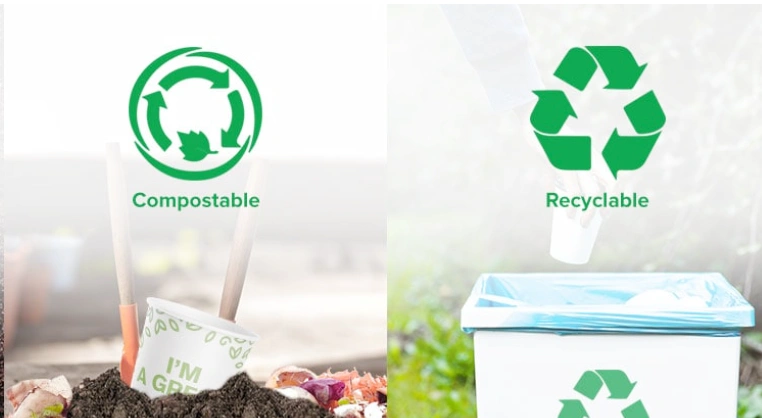
In 2026, Recyclable primarily refers to Mono-Material structures (typically Mono-PE or Mono-PP). Unlike traditional multi-layer pouches that fuse incompatible plastics, mono-materials can be processed in existing recycling streams.
- Best For: Brands prioritizing Shelf Life and Global Scalability.
- The 2026 Edge: With the expansion of advanced mechanical recycling, Mono-PE pouches now achieve nearly the same oxygen and moisture barrier properties as traditional PET/AL/PE structures.
- B2B Advantage: Lower cost per unit compared to compostables and wider acceptance in curbside recycling programs across North America and Europe.
Compostable Packaging: The Zero-Waste Premium
Compostable packaging is designed to break down into organic matter. In 2026, the industry has shifted toward Home Compostable (TUV OK Compost Home) certifications, as industrial composting infrastructure remains uneven.
- Best For: Organic brands, premium coffee roasters, and Eco-First startups.
- The 2026 Edge: Newer bio-based resins (like high-barrier PLA and NKME) have solved the brittleness issue of early compostable films, offering a premium, tactile matte finish that consumers associate with high-end sustainability.
- B2B Challenge: Shorter material shelf life (usually 10–12 months) means brands must maintain an agile, just-in-time inventory strategy to avoid material degradation in the warehouse.
Key Comparison: At a Glance
| 기능 | Recyclable (Mono-PE) | Compostable (Bio-based) |
| Barrier Level | Excellent (High-barrier coatings) | Good (Best for dry/short-life goods) |
| End-of-Life | Mechanical Recycling | Home or Industrial Compost |
| Cost Profile | 15–25% Premium over Standard | 40–70% Premium over Standard |
| Durability | High (Excellent puncture resistance) | Moderate (Sensitive to humidity/heat) |
Making the Choice: Compliance & Consumer Perception
In 2026, the right choice often depends on your target region’s legislation:
- EU Market: Strong push toward Recyclability and Design for Recycling (D4R) guidelines.
- North America: High consumer demand for Compostable options, though Recycle-Ready remains the practical volume leader for mass-market retail.
Pro Tip: If your product requires a 24-month shelf life (like liquid-based snacks or high-oil pet food), Mono-Material Recyclable is currently the more stable and cost-effective B2B solution.
Why Supply Chain Agility Matters in 2026
Switching to sustainable materials requires a manufacturing partner who understands Material Science—not just bag conversion. Testing seal strength and barrier integrity for new eco-structures is critical to preventing costly product recalls.
Lebei 소개: 전략적 패키징 파트너
1995년에 설립되었습니다, Lebei 는 고효율 공급망 솔루션을 전문으로 하는 최고의 연포장재 도매 제조업체입니다. 150명 이상의 전문가와 함께 20,000평방미터 규모의 시설에서 운영되는 당사는 고급 ODM/OEM 서비스와 함께 바로 배송 가능한 2,000,000개 이상의 일반 파우치 재고를 보유하고 있습니다.
Serving brands in 50+ countries, we combine 29 years of industrial expertise with the agility needed for modern batch purchasing. Whether you are transitioning to Mono-PE Recyclable structures or exploring the latest in Compostable films, Lebei provides the technical precision and scale to future-proof your brand’s packaging.